When the Machines Take the Work, Who Tells Us We Matter?

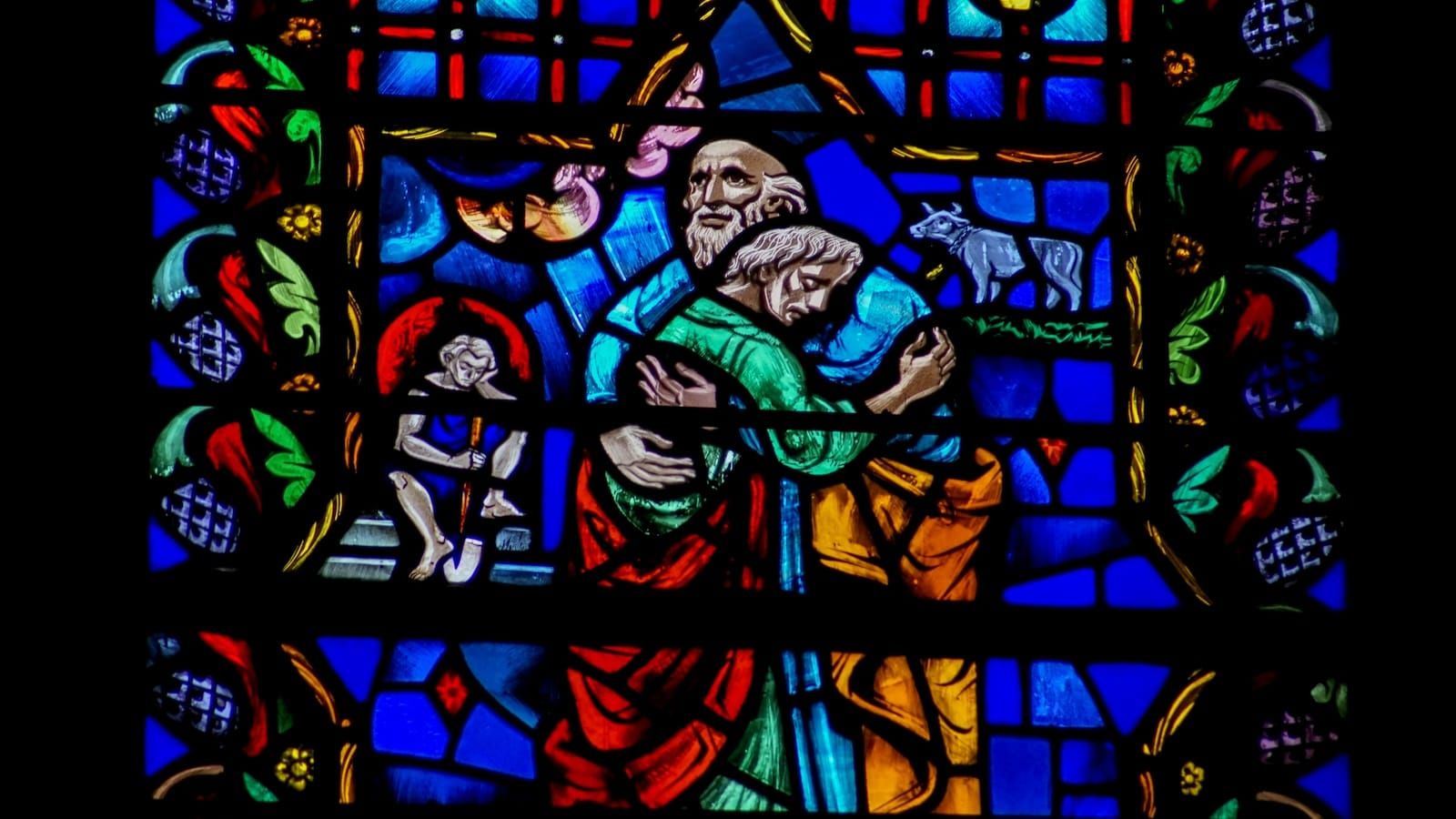
The church's oldest answer to AI's newest crisis.
Something strange happened recently: the Pope and a co-founder of an AI company said essentially the same thing. In his encyclical Magnifica Humanitas, Pope Leo XIV warned that rapid automation risks leaving many in "forced inactivity," and named the stakes plainly: "In the era of artificial intelligence, when human dignity is threatened by new forms of dehumanization, ours is the pressing duty to remain profoundly human." Weeks earlier, standing at the Vatican itself, Anthropic co-founder Christopher Olah — one of the people actually building these systems — framed AI-driven job displacement as a moral emergency and confessed the strangeness of his own creation: "AI models are made from us, from our worlds, and they are far more subtle and odd and beautiful than science fiction prepared us for."
When the people building the technology and the shepherd of 1.5 billion Catholics arrive at the same warning from opposite directions, it's worth stopping to listen.
Here is the warning, stripped to its core: work gives people more than a paycheck. It gives identity, dignity, belonging, a reason to get up, a way to answer the question who are you? at a dinner party. If AI displaces work at the scale many now expect — and the disruption has already begun in coding, customer service, writing, design, and analysis — then even a generous policy response that replaces the income will not replace what else was lost. You can send someone a check. You cannot send them a sense that they matter.
That second problem is not an economic problem. It is a spiritual one. And it is heading straight for our congregations.
The wave will reach the pews first
Policy moves slowly. Grief does not. Long before legislators settle on retraining programs or income supports, the human fallout will arrive where human fallout always arrives: in families, in friendships, and — for those who still have one — in faith communities.
Some of it will look like what pastors already know. A member loses a job and the household tightens. But some of it will be new. The fifty-four-year-old project manager whose entire profession is contracting, just lost her position. The young coder who did everything right — the degree, the skills, the hustle — and entered the market just as the market stopped needing him. The call-center worker whose job didn't move overseas; it simply ceased to exist as a thing humans do.
And much of it won't announce itself. People in this kind of crisis rarely stand up during joys and concerns. More often they quietly disappear — from worship, from the small group, from the giving records — because church can be a hard place to be when the polite opening question is "and what do you do?"
That question is about to become an act of unintentional cruelty for a lot of people. Congregations that notice this early will be congregations that can help.
The church is oddly well-provisioned for this
Here is the part that gives me hope. Christianity has spent two thousand years insisting — against empire, against slavery, against industrial capitalism, against every system that wanted to price human beings by their output — that a person's worth is not a function of their productivity.
We say it in our first pages: humans bear the image of God before they ever plant a field. It is a status conferred, not earned. We say it in the Sabbath commandment, which is not a productivity hack but a weekly act of defiance — a declaration that people made in God's image are not machines for making things, and that even the land itself gets to rest. Israel received that commandment as a formerly enslaved people; Sabbath was the practice of remembering they were no longer valued only for their labor. We say it in the doctrine of grace, the scandalous claim that God's regard for us cannot be earned by works — which means it also cannot be forfeited by unemployment. And Jesus, pressed on this exact anxiety, pointed at birds: they neither sow nor reap, and they are fed. Consider the lilies. Your worth precedes your work.
This is not a sidebar in Christian theology. It is close to the center of it. Which means the church may be one of the few institutions in our society that has language ready for the question AI is about to force on millions of people: if I am not what I produce, what am I?
We have an answer. We've had it a long time. The question is whether we still believe it ourselves.
The uncomfortable mirror
Because — let's be honest — the church has done its own quiet baptizing of productivity culture. We count attendance the way companies count revenue. We describe ministries by their output. We burn out pastors by treating them as content-and-care machines, then act surprised when they break. Clergy themselves are not exempt from the coming displacement anxiety; surveys now show most preachers using AI in sermon preparation, and more than a few wondering, privately, what parts of their own vocation are next.
A church that measures itself the way the economy measures people will have nothing to say to people the economy has discarded. Before we offer the world a theology of worth beyond work, we need to sit with whether our own common life embodies it. This may be one of those moments when the crisis outside the church becomes a gift to the church — forcing us back to convictions we had been managing instead of living.
A word from a church that has been here
Some Christian communities are not encountering this question for the first time. The Black church in America was born among people whom the surrounding economy valued only as labor — who were, in the ledger books of that economy, literally priced. Frederick Douglass, opening My Bondage and My Freedom, chose an epigraph naming exactly the principle that slavery denied: "a PERSON is eternally differenced from a THING; so that the idea of a HUMAN BEING, necessarily excludes the idea of PROPERTY IN THAT BEING." And within the community that survived that denial arose a defiant counter-testimony: you are a child of God. Not a hand, not a unit of production, not a line item. Somebody. James Cone, the father of Black liberation theology, distilled it: "God is whatever color God needs to be in order to let people know they're not nobodies, they're somebodies."
That tradition — its preaching, its songs, its practice of conferring dignity on people the world refused to dignify — is not a historical curiosity. It is expertise. As AI-driven displacement spreads anxiety about human worth into populations that have never had to question theirs, the communities that survived having their worth denied for centuries hold wisdom the whole church needs. Ecumenism, in this moment, is not a nicety. It is how the body of Christ gets access to its own memory.
What congregations can actually do
I'll resist the temptation to end with a program. But a few postures seem right for communities standing at this threshold.
Learn to ask a different question. "What do you do?" can become "what's giving you life these days?" — a small liturgical change in our coffee-hour liturgy that makes room for people whose answer to the old question just collapsed.
Talk about vocation as bigger than employment — from the pulpit, in formation, with teenagers who are making educational bets in a fog. Christian tradition has always known that calling is not a job title; we need to say so now, out loud, before the layoffs make it sound like consolation.
Practice economic mutual aid without shame. The early church held things in common not as a policy proposal but as a family reflex. Congregations can be places where a job loss is met with casseroles and connections rather than quiet embarrassment.
And grieve liturgically. We have rituals for the losses we saw coming for centuries — death, and lately divorce. We will need prayers, and maybe rites, for the loss of a working identity. If the church doesn't give people a place to mourn that, they will mourn it alone, or not at all, and both are dangerous.
Standing at this threshold
I don't know how fast the displacement will come or how deep it will cut. Serious people disagree. But I know this: every previous technological upheaval eventually forced a renegotiation of what humans are for, and religious communities were always party to that negotiation — sometimes prophetically, sometimes shamefully, rarely neutrally.
This time the question arrives with unusual clarity. The machines are getting good at the things we used to point to when asked why we matter. The church's answer has never depended on those things. Worth, we have always said, is conferred at the source — spoken over us before we produce anything, sustained through every season we produce nothing.
If we can remember that we believe this, and build communities where it is practiced and not just preached, the church may find that this threshold is one it was built to help people cross.
David Cassady is the president of BSK Theological Seminary, the co-founder of Faithlab, and can be heard weekly on the Faithelement Conversations podcast. He is also professor of Christian education and media studies at BSK.