Don't Fall for the Con: Why the Arguments Against EVs Don't Hold Up
If you've found yourself hesitant about making the switch to an EV, it's worth pausing to ask a simple question: who benefits from your hesitation?

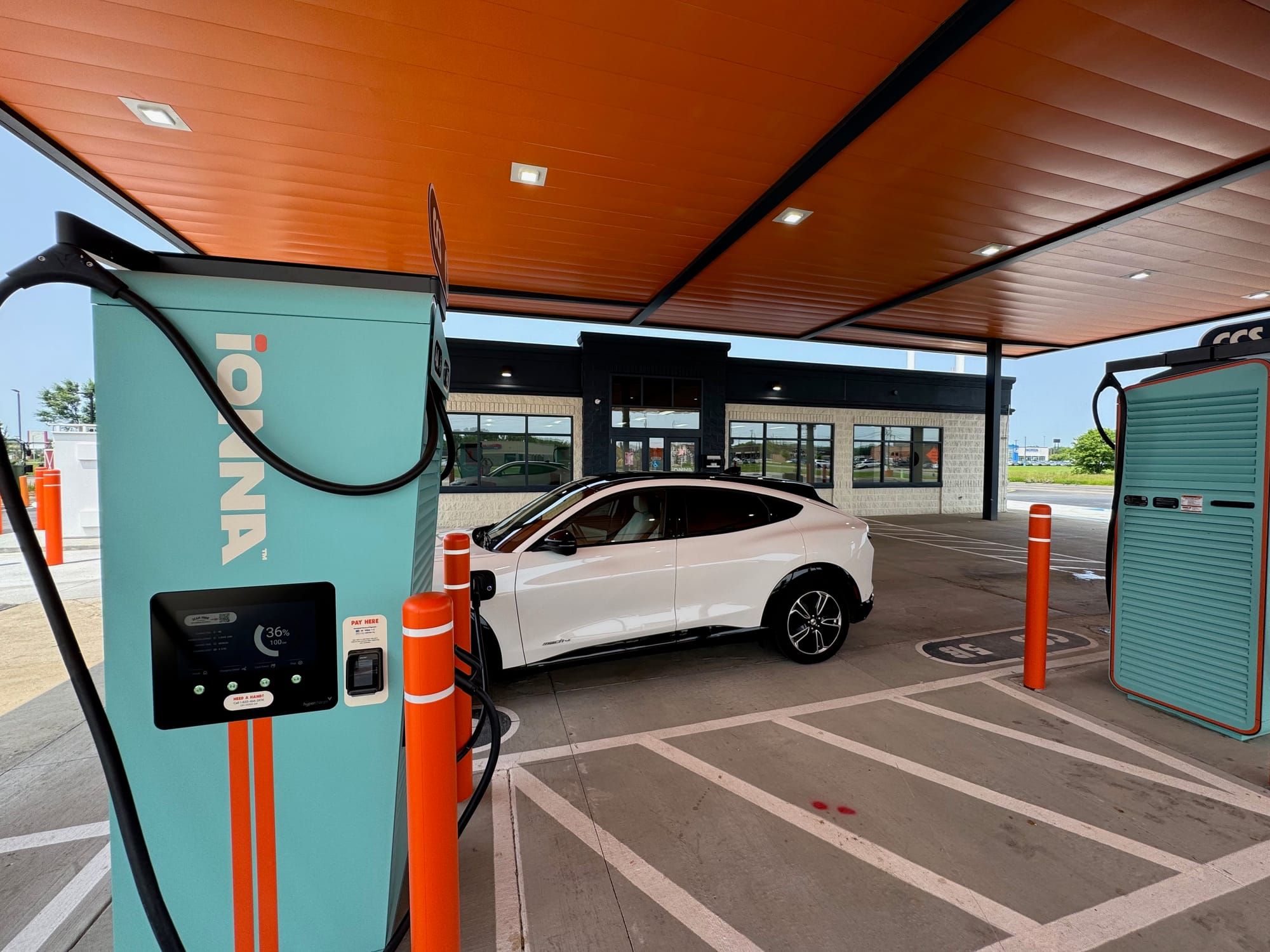
There's a lot of noise around electric vehicles — and much of it is deliberately manufactured.
If you've found yourself hesitant about making the switch to an EV, it's worth pausing to ask a simple question: who benefits from your hesitation? Because the fossil fuel industry — an industry that generates hundreds of billions of dollars in annual revenue and receives tens of billions more in taxpayer-funded subsidies — has a great deal to lose if Americans stop buying gasoline. And when that much money is on the line, disinformation is a reliable tool.
DeSmog has documented how the American Fuel & Petrochemical Manufacturers and the American Petroleum Institute have spent millions running ads, digital campaigns, and billboard blitzes attacking EV policies. Sludge has traced a stealth EV misinformation operation funded by fossil fuel interests. The Koch network has been pouring money into anti-EV campaigns for years. CNBC reported as far back as 2018 that the oil industry was actively "peddling misinformation" about electric vehicles.
None of this is organic skepticism. It's a campaign. And the arguments it produces tend to fall into a few recognizable patterns.
"Something Better Is Almost Here — Just Wait"
This one sounds reasonable. Why buy an EV today when battery technology is improving so fast? Surely the next generation will be dramatically better.
It's a clever argument because it's permanently true. There will always be a better battery coming. There will always be a faster charging standard around the corner. Apply this logic consistently and you'll never buy anything in the technology sector — no smartphone, no laptop, no anything. The same argument could have talked you out of buying a flat-screen TV in 2005 because 4K was coming.
The EVs available today — from Hyundai, Kia, Subaru, Chevrolet, Ford, BMW, Toyota and many others — are genuinely excellent vehicles. They're not prototypes waiting on an upgrade. They're the product of decades of engineering refinement. Waiting for perfection is a strategy that benefits exactly one group of people: those who profit while you keep filling your tank.
"EVs Aren't Perfect"
No, they're not. Neither is anything else.
This argument works by holding EVs to an impossible standard that no technology — and certainly no combustion vehicle — is expected to meet. It identifies a real limitation (battery mining, range anxiety, charging time) and amplifies it until it seems disqualifying, while conveniently ignoring the extraordinary damage done by the internal combustion engine every single day.
Here's the honest comparison: EVs produce significantly less environmental harm over their lifetime than gas vehicles, even accounting for battery production and the current electricity grid. They produce zero tailpipe emissions. They don't require oil changes, transmission flushes, or exhaust system repairs. They are quieter, smoother, and faster off the line. They are, in nearly every practical dimension, a superior daily driver.
The relevant question isn't whether EVs are perfect. It's whether they're better — for the planet, for human health, for our wallets. On all three counts, the answer is yes.
If you hold a creation care ethic — a belief that we are stewards, not owners, of the world we've been given — then the imperfect-but-dramatically-better option carries real moral weight. We don't have to wait for perfection to act faithfully.
"EVs Are Too Expensive"
This argument is more complicated than it first appears, because it's partially true and almost entirely misleading.
Yes, many new EVs carry a higher sticker price than comparable gas vehicles. But the actual cost of driving a gasoline-powered car is heavily obscured — by industry lobbying, by accounting conventions, and by the way we've normalized costs we simply don't see on a bill.
Consider what we're really paying for gas:
Taxpayer subsidies to Big Oil. The federal government hands the fossil fuel industry an estimated $35 billion annually in direct subsidies. A 2025 analysis by FracTracker puts the total benefit — including tax breaks and unpriced externalities — at $760 billion. That's not a free market. That's a heavily subsidized one, and you're footing the bill.
Health costs. Air pollution from fossil fuels is responsible for an estimated 91,000 premature deaths in the US annually, and costs Americans roughly $2,500 each per year in healthcare. Harvard researchers have found that fossil fuel air pollution is responsible for 1 in 5 deaths worldwide. These aren't abstract statistics — they're the real cost of cheap gasoline, and they land hardest on Black, Hispanic, and low-income communities.
Maintenance. Consumer Reports found EV maintenance costs run roughly 50% less than gas-powered vehicles. Typical EV owners spend $150–$400 per year on maintenance versus $900–$1,800 for a comparable gas vehicle. No oil changes. No spark plugs. No transmission. Fewer moving parts means fewer repair bills.
And here's what the "too expensive" crowd rarely mentions: the used EV market right now is exceptional. As of early 2026, 56% of used EV inventory is priced under $30,000, with nearly a third under $25,000 — and more than 300,000 additional lease returns are flooding the market in 2026 alone. These are low-mileage, late-model vehicles at genuinely accessible prices. Used EVs now average just $34,821 — within $1,300 of the average used gas car. The affordability window is open right now.
"EV Charging Is Too Slow"
This argument pictures you stranded at a highway rest stop for three hours, tapping your foot while your car slowly fills up. It's a vivid image. It's also not how most EV drivers experience their lives.
The vast majority of EV charging — studies put it at roughly 80% — happens at home or at work overnight. You plug in when you get home, wake up to a full "tank," and never visit a gas station. That's not slower than fueling a gas car; it's faster and more convenient, because you never have to go out of your way to do it.
For road trips, modern DC fast chargers can add 100-200 miles of range in 20-30 minutes — enough time for a bathroom break and coffee. The key insight the critics miss is that you don't need to charge to 100% at a highway charger. Charging to 80% is faster, better for the battery, and almost always sufficient to reach your next stop.
Rejeana and I do multiple 6-9 hour road trips per year in an EV with no issue. Frankly, my bladder or rumbling tummy needs to stop more often than our car!
"The Charging Infrastructure Isn't There Yet"
A few years ago, this argument had real merit. Today, it's largely myth.
The United States ended 2025 with more than 70,000 public DC fast-charging ports — up 30% from a year earlier, and roughly four times the number that existed in 2022. Charging reliability has improved dramatically, with a nationwide average reliability rate of 93.3%. At the current pace of deployment, the US will pass 100,000 fast-charging ports by 2027.
People are driving EVs across the country every day. And if you want a stress test for cold-weather range anxiety, look no further than Norway. As of 2025, 98.3% of newly registered vehicles in Norway are fully electric — in a country where temperatures regularly plunge well below freezing. In Norway's northernmost regions, where it can hit -20°C or colder, the EV adoption rate is just as high as in the rest of the country. Norway's own roadside assistance data shows that in extreme cold, electric vehicles actually have fewer starting problems than combustion engines.
The "infrastructure isn't ready" argument is becoming less defensible every month.
We Can't Afford to Wait
I want to be direct here, because this is where I think a lot of the conversation gets soft when it shouldn't.
The cost of burning fossil fuels is not theoretical. It is measured in lives — over 90,000 premature deaths per year in the United States alone. It is measured in climate disruption — droughts, floods, displacement, and all the cascading human suffering those bring. It is measured in wars fought over oil. It is measured in children and grandchildren inheriting a planet more stressed than the one we received.
And that last one deserves more than a passing mention. Researchers at Harvard's Belfer Center have documented that between one-quarter and one-half of all interstate wars since 1973 have been linked to oil. The Gulf War of 1990–91 was fought, in no small part, because Saddam Hussein's seizure of Kuwait put him within striking distance of controlling most of the world's petroleum reserves. The Iraq War, whatever its stated justifications, was inseparable from America's strategic need to maintain access to Middle Eastern oil. Today we are engaged in a war with Iran that is predicated on the value and need for oil. When you fill your tank, there is a line — indirect, complicated, and real — connecting that transaction to American soldiers, and real families across the Middle East, and decisions made in rooms most of us will never see.
Researched before the current conflict, Brown University's Costs of War Project has estimated that over 940,000 people were killed by direct violence in post-9/11 wars across Iraq, Afghanistan, Syria, Yemen, and Pakistan — more than 432,000 of them civilians. When indirect deaths from the destruction of healthcare systems, economies, and infrastructure are included, the toll rises to an estimated 4.5 to 4.7 million people. These are staggering numbers, and they are part of the true cost of our fossil fuel dependency — a cost that never shows up at the pump. If we believe, as people of faith have always believed, that every human life bears sacred worth, then that ledger matters.
If we take seriously the idea that this creation is not ours to consume without consequence — that there is something at stake beyond our immediate convenience — then the calculus changes. The question shifts from "Is an EV perfect enough for me?" to "What kind of steward do I want to be?"
EVs are not a sacrifice. They are genuinely great cars — quiet, fast, fun to drive, packed with technology, and remarkably cheap to operate. They are better for the air your neighbors breathe. They are better for the climate your grandchildren will inherit. They are better, full stop.
The propaganda is designed to keep you confused until it's too late — or at least until the next quarterly earnings report. Don't let it.
When you can, make the switch. Creation will thank you. And the generations coming after us will be grateful we didn't keep falling for the con.
David Cassady is the president of BSK Theological Seminary, the co-founder of Faithlab, and can be heard weekly on the Faithelement Conversations podcast. He and his wife both drive EVs and might be charging them right now at their home in Lexington, Kentucky.
Sources: Belfer Center / Oil & Conflict | Brown University Costs of War | DeSmog | Sludge | CNBC | Oil Change International | FracTracker | Time / SEI | World Economic Forum | Harvard T.H. Chan | Consumer Reports / Great Plains Institute | Recurrent Auto | JD Power | Paren 2025 Fast Charging Report | Go Electra / Norway EV Stats | Illuminem / Norway Range